

A coach I spoke with recently told me she had no idea how much money she was actually making. Not roughly. Not ballpark. She genuinely didn't know. She knew she was teaching, billing clients, sending invoices — but tracking who paid, who didn't, whether the follow-up email went out? That had all slipped. Her brain couldn't hold it alongside the actual work of being a great teacher. So the admin got buried. And every day, a little more visibility disappeared.
A few days later I sat with a team lead at a mid-size company. She was spending 40 minutes after every meeting manually copying action items from a shared doc into the project tracker, then pinging each person on chat to confirm they'd seen their tasks. Then following up two days later when half of them hadn't. Then compiling a status update from the responses. Every week. For every project. She wasn't inefficient — she was drowning in process that nobody had ever questioned.
Two different people. Same sentence: "This is just how it is."
Every time I run an automation audit, I hear some version of that phrase. And every time, it turns out it's not "just how it is." It's how it is when nobody stops long enough to look.
What an Automation Audit Actually Is
It's not me walking in with a checklist of tools and looking for places to plug them in. It's not a 30-slide deck about "digital transformation." And it's definitely not a sales pitch disguised as consulting.
An automation audit is a focused, 1-2-hour deep dive into how a business actually runs day-to-day. The goal is simple: find the 3 to 5 processes that are eating the most time while producing the least value, and map out exactly how to fix them.
The outcome isn't "you need to buy this software." It's a prioritized roadmap — what to fix first, what to fix later, and what to leave alone entirely. Sometimes the answer is "stop doing this task altogether." That's a valid finding too.
You're not buying automation. You're buying your time back.
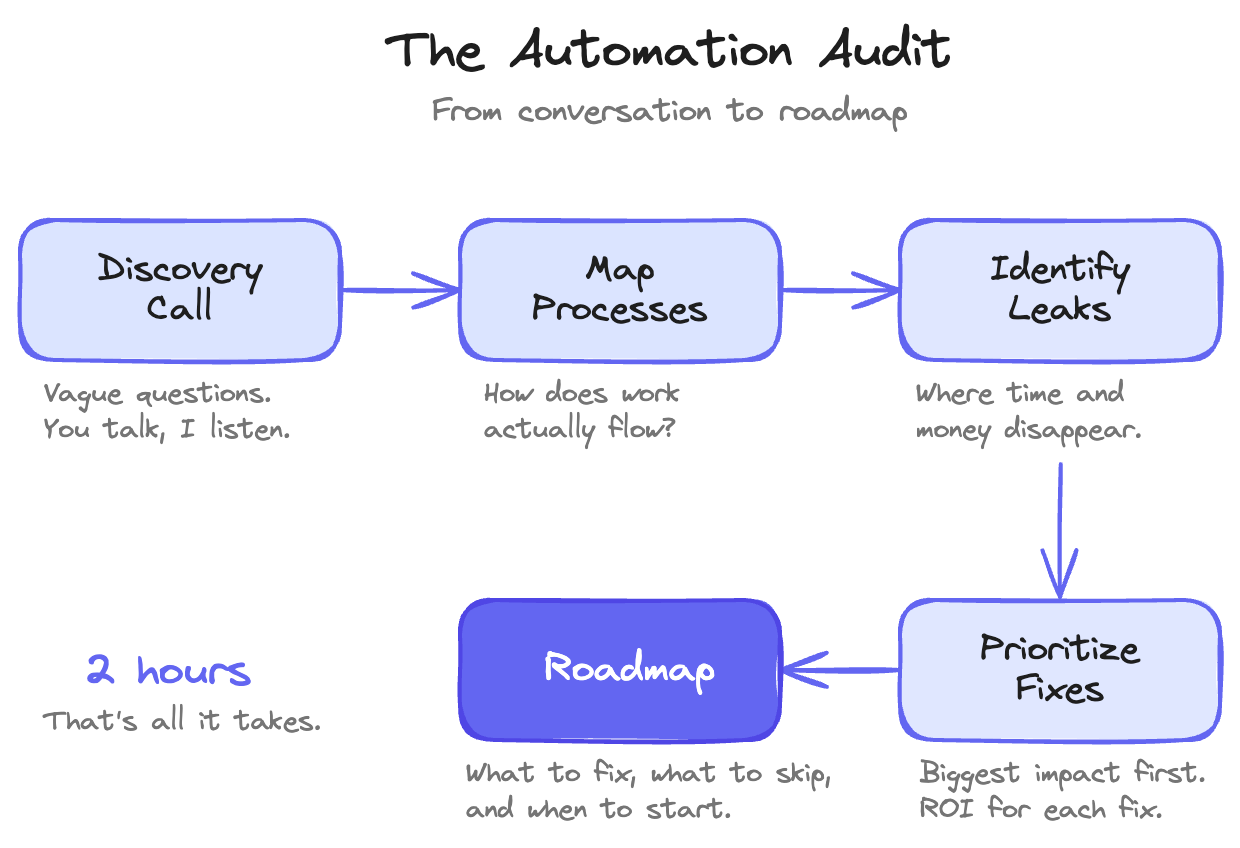
The Real Method: Vague Questions, Sharp Listening
Here's something most consultants won't admit: the best diagnostic tool isn't a framework. It's a deliberately vague question and the patience to shut up afterward.
I'll ask something wide open like: "Walk me through what happens after a new client says yes." And then I wait. I don't interrupt. I don't steer.
People start talking. They speed up when they hit the parts that frustrate them. They slow down when describing steps they've never questioned. They say things like "and then I have to manually..." or "this part is annoying but I just deal with it." Those throwaway comments? That's where the gold is.
It's a bit like a therapy session — they get to steam off about everything that's been piling up. The messy parts, the workarounds they built at 2 AM, the processes they're embarrassed about. But unlike therapy, you don't leave with more questions than you came in with. Once you've told me where it hurts, I name the root cause and tell you how to fix it. Not "we should explore this further." Right there, in that conversation. Root cause, solution, timeline.
The vague questions aren't random — they're designed to let you talk freely so I can hear what you can't see anymore. The processes you've normalized. The workarounds you've stopped questioning. The time leaks you've accepted as "just how things are."
The 5 Time Leaks an Automation Audit Catches Every Time
After doing this enough times, patterns emerge fast. Almost every small business or solo practice has at least three of these:
1. Manual Invoicing and Follow-Ups
The owner creates invoices by hand — maybe in Word, maybe in some basic tool. Sends them manually. Tracks who paid in a spreadsheet or, worse, from memory. Then spends time every week chasing late payments with awkward follow-up emails.
The coach I mentioned earlier? This was her biggest leak. She wasn't losing clients — she was losing visibility. She couldn't tell you on any given day how much she was owed, by whom, or whether she'd even sent the invoice. The core of her business — teaching — was great. Everything around it was falling through the cracks. And because she couldn't keep up with the admin, it bled into her actual work — noise in her head during sessions, a constant low-level stress about things slipping.
What this costs: 3-5 hours per week, plus the stress and delayed cash flow.
What the fix looks like: Automated invoice generation triggered by project completion or appointment booking. Payment reminders that send themselves. A simple view that shows who owes what without digging through email.
2. Copy-Paste Data Entry
Client information lives in three places — a CRM (or spreadsheet pretending to be one), an email thread, and maybe a shared doc. When something changes, someone has to update all three. Manually. They usually forget at least one.
What this costs: Beyond the hours, it costs trust. Wrong phone numbers, outdated addresses, conflicting records. One consultant I spoke with had two different email addresses for the same client in two different systems — and had been emailing the wrong one for weeks.
What the fix looks like: One source of truth. Data enters once and syncs everywhere it needs to go. No copy-paste, no "did I update the other sheet?"
3. Scheduling Ping-Pong
Five emails to book a single meeting. "How about Thursday?" "Thursday doesn't work, what about next week?" "Next week is tight, maybe Wednesday afternoon?" This dance happens for every new client, every follow-up, every internal meeting.
What this costs: 30 minutes to an hour per meeting, multiplied by however many meetings you book per week. For a consultant doing 8-10 client meetings a week, this is easily 5+ hours of pure waste.
What the fix looks like: A booking link with your real availability. The client picks a slot, it's confirmed instantly, calendar is blocked, reminder goes out automatically. This is the easiest fix on the list and yet the number of businesses still doing it manually is staggering.
4. Weekly or Monthly Report Generation
Every Monday morning (or the first of every month), someone sits down and pulls numbers from three different tools, copies them into a spreadsheet or a slide deck, formats everything, and sends it out. Same report, same format, same process. Every single time.
What this costs: I automated this exact process for a 10-person operations team. One person was spending roughly 15 hours every week assembling a report that pulled data from their CRM, two spreadsheets, and an email chain — not because the report was complex, but because the data was scattered and had to be gathered, cross-checked, and formatted by hand. After the fix, the report generated itself. That team got back over a third of their operational time, and the automated version is still running two years later without anyone touching it.
What the fix looks like: Automated data pull, auto-formatted report, delivered to the right inbox on schedule. (If you're curious what building one of these automations actually looks like, I wrote about a similar process in my WhatsApp chatbot build log.) The first time a client sees their Monday report arrive at 7 AM without anyone touching it, the reaction is always the same: "Wait — nobody did this?"
5. Client Onboarding
A new client signs up. Now someone needs to send a welcome email, share a document or form, set up their account in whatever tool you use, schedule the kickoff call, and maybe add them to a group or channel. Each step is simple. But it's 15-20 minutes of manual work per client — and if you forget a step, the client notices.
What this costs: Time, obviously. But also first impressions. A clunky onboarding experience signals "this person isn't organized." A smooth one signals "I'm in good hands."
What the fix looks like: One trigger (client signs contract or pays) kicks off the entire sequence automatically. Welcome email, documents shared, calendar link sent, internal records updated. The client experiences a seamless start. You didn't lift a finger.
What Happens After the Audit
For the coach, the roadmap was straightforward: fix invoicing first (recover ~5 hours/week and stop the cash flow bleed), then automate client onboarding (another 2-3 hours plus a better first impression). Total cost of the audit was less than the value of a single week of recovered time.
That's the pattern. You walk away with:
A prioritized list of fixes — not everything at once. The roadmap tells you what to tackle first, usually the fix that saves the most time with the least effort.
An ROI estimate for each fix. Hours saved per week, multiplied by what your time is worth. If a fix saves you 5 hours a week and your hourly value is €50, that's €1,000/month in recovered time. The math does the selling.
Honest recommendations. Sometimes I tell people not to automate something. If a process only takes 10 minutes a week and would require a complex setup to automate, it's not worth it. The goal is impact, not automation for its own sake.
And a safety net. Every automation I build includes monitoring — if something doesn't fire or behaves unexpectedly, you get notified before your client notices anything. You're not trading manual work for anxiety about whether the machine is running. It runs, and you know it runs.
Most businesses only need 2-3 targeted fixes to feel a dramatic difference. You don't need to overhaul everything. You need to find the right levers.
The Real Reason I Do This
I'll be honest about something: the state of things frustrates me.
I sit in meetings, I talk to business owners, I watch smart, capable people spend hours clicking the same buttons, copying the same data, formatting the same reports — and when you ask why, the answer is always "this is just how things are" or "I don't have time to make time."
I get it. The system doesn't give you room to stop and look. You're too busy working to question how you work.
I know this because I was there. I only got to where I am now because at some point I stopped, looked at all the noise around my own work, and decided to deal with it first. Not later. Not when things calm down. First. And now people ask me how I manage to do so many things, how I deliver in days what others take months for. The answer isn't that I'm faster or smarter. It's that I eliminated the noise.
That's what an automation audit really is. Not a tool pitch. Not a tech flex. It's permission to stop, look at the machine, and ask: does it have to be this way?
It almost never does.
Add It Up
Most of the businesses I audit are losing 10-15 hours a week to processes that could be fixed in days. At even a modest hourly rate, that's easily €2,000/month walking out the door — month after month, compounding silently.
The audit takes 2 hours. The fixes usually pay for themselves within the first month. The question isn't whether you can afford to do it. It's how long you can afford not to.
Book a free 30-minute call — I'll tell you within the first few minutes whether an audit would actually save you money. No pitch, no pressure. If it doesn't make sense, I'll say so.